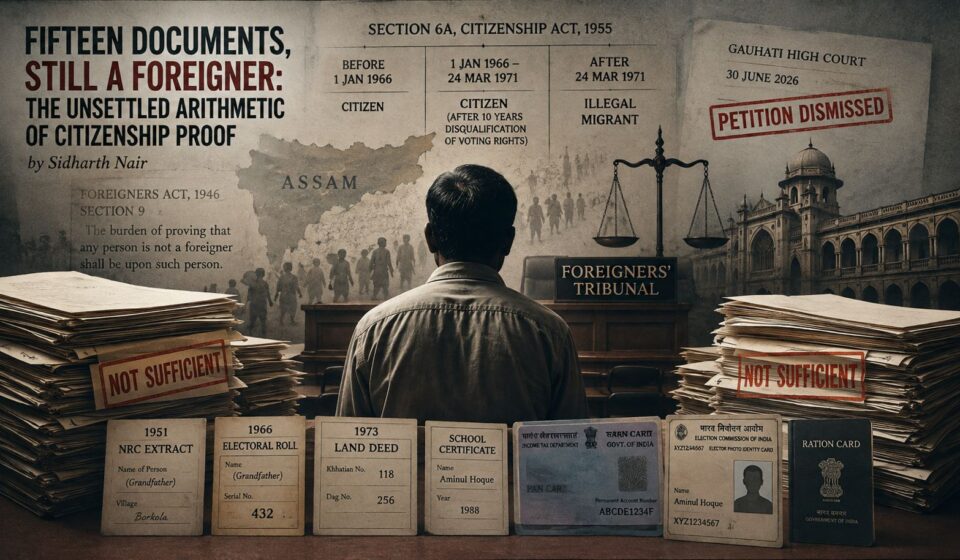

On 30 June 2026, a Division Bench of the Gauhati High Court dismissed the writ petition of Aminul Hoque, a 38-year-old daily-wage labourer from Kamrup, Assam, thereby upholding a Foreigners’ Tribunal opinion that had branded him a foreigner seven years earlier. What makes the order noteworthy is not the outcome; Foreigners’ Tribunals dismiss the overwhelming majority of citizenship claims placed before them. However, it was the sheer volume of paper Hoque had marshalled in his defence: fifteen documents, including but not limited to an extract from the 1951 National Register of Citizens naming his grandparents, electoral rolls from 1966, a 1973 land deed, a school certificate, his PAN card and his Voter ID were all placed before the Tribunal and subsequently the High Court. None of it sufficed. Justices Kalyan Rai Surana and Shamima Jahan held that Hoque had failed to discharge the burden cast upon him by Section 9 of the Foreigners Act, 1946; a burden that, as this piece will argue, Indian law has quietly rendered almost impossible to satisfy through documents alone.
If this sounds familiar, it should. Almost exactly six years before Hoque’s case made headlines, the same High Court rejected an identical quantum of proof from Jabeda Begum, a fifty-year-old woman who had also produced fifteen documents, being her PAN card, bank records, land revenue receipts among them, only to be declared a foreigner because she could not establish an unbroken documentary link to a pre-1971 ancestor. The coincidence of the number is almost too perfect for satire, but it makes a serious point: the evidentiary standard applied by Foreigners’ Tribunals has not moved in half a decade, notwithstanding tectonic shifts in the surrounding constitutional landscape.
House divided over the EPIC?
The confusion is not confined to Assam, nor is it new. On a single day in February 2020, the Indian judicial system managed to say two rather different things about the same category of document. A Gauhati High Court Bench held, in the case that felled Munidra Biswas, that an Electoral Photo Identity Card (EPIC) is no proof of citizenship at all, as a person can register to vote on the strength of a declaration alone. At the same time, 2,636 kilometers away, a trial court in Mumbai reached the opposite conclusion, acquitting two persons accused under the Foreigners Act precisely because their Voter ID cards were treated as sufficient proof of citizenship, on the ground that the declaration accompanying a voter application is itself a sworn assertion of citizenship. Two courts, one document, contradictory verdicts. Neither the Election Commission nor Parliament has stepped in to settle which reading governs outside the specific facts of each case. For an unfortunate lawyer who has to advise a client on documentary strategy, this is less a rule than a coin toss dressed up in robes.
The Statutory Architecture of Suspicion
Sections 8 and 9 of the Foreigners Act, 1946 place the onus of proving Indian citizenship squarely on the individual, not the State; an inversion of the ordinary presumption of innocence that has survived scrutiny because the Supreme Court, in Sarbananda Sonowal v. Union of India, found it in line with Section 106 of the Evidence Act: facts especially within a person’s own knowledge must be proved by that person. The Court went further, holding that a claimant must ordinarily furnish “evidence of his date of birth, place of birth, name of his parents” and their antecedents. It was this very judgment that struck down the more claimant-friendly Illegal Migrants (Determination by Tribunals) Act, 1983 which had shifted the burden onto the State within Assam. Since 2005, then, the deck has been stacked deliberately, and with judicial affirmation against the person in the dock.
Section 6A: A Return (of Sorts) of Constitutional Certainty
The Assam Accord of 1985 introduced Section 6A into the Citizenship Act, 1955 creating a bespoke regime for the State: those who entered before 1 January 1966 were deemed citizens outright; those arriving between that date and the midnight of 24/25 March 1971 received citizenship with a decade’s suspension of voting rights; anyone crossing the threshold thereafter remains an illegal migrant liable to detection and deportation. For nearly forty years, litigants and academics wondered whether this Assam-specific carve-out, a jus soli principle diluted almost past recognition by the various amendments could survive an equality challenge. The question was answered, at some length, in October 2024 when a Constitution Bench delivered its verdict in In Re: Section 6A of the Citizenship Act, upholding the provision by a 4:1 majority which entrenched 1971 as the operative constitutional benchmark and, by necessary implication, fixed the entire Tribunal-driven, documents-first machinery that decides which side of that line a person falls on.
Quantity ≠ Quality
What distinguishes the Hoque order from a mere rehash of Jabeda Begum’s is its explicit articulation of why fifteen documents can amount to nothing. The Bench found his PAN card and Electoral Photo Identity Card were, per settled precedent, no proof of citizenship at all; administrative artefacts tethered to residency rather than nationality. His school certificate fared no better: the custodian who might have authenticated it was never examined and the original admission register had gone missing, leaving the document unproved in the manner the Indian Evidence Act demands. Even his own father’s oral testimony, which is arguably the most direct human evidence of lineage available to him, was held incapable of substituting for documentary proof. What emerges is a hierarchy in which quantity is nearly irrelevant and admissibility is everything: a fifteen-document dossier riddled with procedural infirmities is worth exactly as much as a single, unimpeachable one: nothing and everything, respectively.
The Passport Postscript
As if timed for irony, the Ministry of External Affairs used Passport Seva Divas, i.e. 24 June 2026, less than a week before the Hoque verdict to remind the public that even a passport, the document most citizens instinctively regard as the gold standard of national belonging, is not conclusive proof of citizenship. The clarification rested on Section 20 of the Passports Act, 1967 which permits issuance of travel documents to non-citizens where the public interest so requires and echoed a 2013 Bombay High Court ruling to similar effect. Aadhaar and driving licences had already been consigned to this evidentiary purgatory the former expressly tied to 182 days’ residency under the Aadhaar Act, as the UIDAI has repeatedly clarified and the passport’s demotion completes a rather bleak inventory. One is left wondering on what document short of a time-stamped birth video would actually move the needle.
A Rarely Used Escape
Curiously, the very statute imposing this onerous burden also contains a humanising counterweight. Section 8 of the Foreigners Act permits a person of uncertain nationality to be treated as a national of the country with which they are most closely connected “in interest or sympathy.” The Delhi High Court invoked precisely this provision in Prabhleen Kaur v. Union of India by declining to entertain belated doubts about a woman’s citizenship where she had lived her entire life in India with no discernible ties elsewhere and drawing further support from the Supreme Court’s reluctance in Gangadhar Yeshwant Bhandare v. Erasmo De Jesus Sequiria to render a person stateless. This humanitarian register has, however, remained confined largely to cases outside Assam’s statutory ecosystem; the Accord’s specificity has proved a formidable barrier to its migration northeastward.
Conclusion
The Hoque order is not an aberration but a fairly faithful application of a doctrine that has hardened, not softened, over the past six years against the backdrop of an IndiaSpend-documented reality that roughly 38% of Indian children under five lack birth certificates, an NRC exercise that excluded nearly nineteen lakh people, and now a Constitution Bench verdict that has foreclosed constitutional challenge to the underlying framework. Whether the law has struck the right balance between screening out fraudulent claims and avoiding the manufacture of statelessness among the genuinely marginalized remains a live and, I would submit, insufficiently examined question on which reasonable jurists continue to disagree. What is no longer in dispute is the practical lesson for practitioners: before a Foreigners’ Tribunal, it is not the weight of the file that matters but whether every page in it can survive cross-examination. Fifteen documents, it turns out, are simply fifteen separate chances to be found wanting.
Cases Cited (in order):
- Aminul Haque v. Union of India – WP(C) 5471/2019
- Jabeda Begum v. Union of India – WP(C) 7451/2019
- Munindra Biswas v. Union of India – WP(C) 7426/2019
- Sarbananda Sonowal v. Union of India – (2005) 5 SCC 665
- In Re: Section 6A of the Citizenship Act – 2024 SCC OnLine SC 2880
- Prabhleen Kaur v. Union of India – 2018 SCC OnLine Del 11650
- Gangadhar Yeshwant Bhandare v. Erasmo De Jesus Sequiria – (1975) 1 SCC 544