
I. Six Months’ Notice
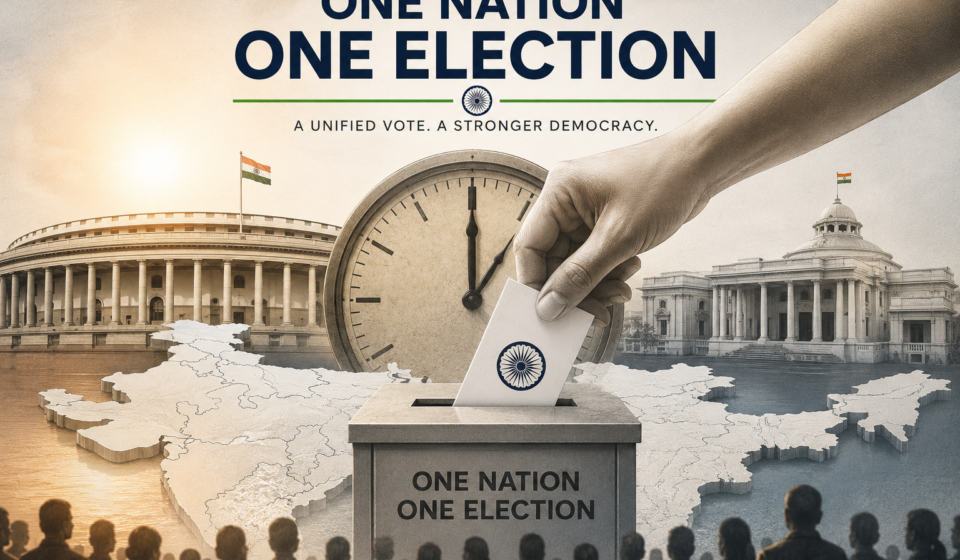
A few days ago in Lucknow, the Election Commission told a room full of lawmakers that it could pull off One Nation, One Election with just six months’ notice.[1] The Joint Parliamentary Committee had spent three days there consulting law schools and universities on the finer points of the bill, and its chairman, P.P. Chaudhary, walked out afterward and said the quiet part out loud: if Parliament passes the law by 2028, India could vote simultaneously by 2029.[2] That is no longer a distant hypothetical being debated in a committee room. It is a target date, spoken aloud, with the Election Commission nodding along.
Which makes this a good moment to ask what exactly Parliament will be passing, and what it will cost the states asked to fall in line with it.
The story so far, briefly: the High Level Committee headed by former President Ram Nath Kovind submitted its report in March 2024, recommending that Lok Sabha and State Assembly elections be brought back onto a shared clock, something India last managed, more by accident than design, between 1951 and 1967.[3] By December that year, the idea had become a bill. The 129th Amendment Bill, along with a companion Union Territories Laws Amendment Bill, was introduced in the Lok Sabha on 17 December 2024 and cleared introduction by a vote of 269 to 198.[4] Both bills went to the same Joint Parliamentary Committee now holding consultations in Lucknow, whose deadline has been pushed back more than once, most recently to the Monsoon Session of 2026.[5]
On the surface, the debate is about cost and convenience. Underneath it, there is a question the Constitution has never really had to answer with any precision: how much synchronising can a federation take before it stops behaving like one.
II. A Clock Built for a Country That Has Since Changed Its Mind
Article 82A, the heart of the bill, does not force every state election onto the same starting line. It does something quieter and, honestly, more consequential. It fixes one date, the first sitting of the new Lok Sabha, and recalculates every State Assembly’s term to end alongside Parliament’s, no matter when that Assembly actually took office.[6] A state that votes in year one of a five year Lok Sabha term gets a full run. A state that votes in year four gets one year in office, then has to dissolve and wait its turn. This is not synchronisation in the sense of everyone starting the race together. It is synchronisation in the sense of everyone being made to finish together, whatever that costs the state that started late.
This is where India’s own history stops being a comforting precedent and starts looking like a warning. The original simultaneous cycle did not fall apart because Parliament legislated it away. It fell apart because Assemblies kept dissolving early, through defections, no confidence motions, President’s Rule, and nothing in the Constitution at the time pulled the system back into line.[7] Article 82A tries to fix that old failure after the fact, but the only way it can do so is by giving the Union, through the President and the Election Commission, an ongoing power to shorten a state government’s elected term whenever national scheduling calls for it. A clause meant to stop 1967 from happening again ends up recreating the very thing that made 1967 possible in the first place: central control over how long an elected state government gets to stay in office.
III. Whose Basic Structure Is It Anyway
Whenever this bill comes up in a law school seminar or a courtroom argument, someone reaches for S.R. Bommai v Union of India, where a nine judge bench held that federalism is not just good policy but part of the Constitution’s basic structure, as protected from ordinary amendment as judicial review or the separation of powers.[8] That instinct is correct, but it is often used too casually, as if citing Bommai ends the conversation. It does not, because Bommai was about the misuse of Article 356 to dismiss elected state governments for political convenience, not about whether Parliament can prospectively adjust election timing through a proper constitutional amendment. The two situations are related. They are not the same thing.
What Bommai really gives us is not a verdict on this bill but a test. It tells us that federalism, as a basic feature, protects something specific: a state’s ability to exist as its own political unit, answerable to its own voters on its own timeline, rather than as an administrative branch office that reschedules itself whenever it suits the Union.[9] Whether Article 82A crosses that line depends on something the bill’s drafters have stayed vague about. Clause 5 of Article 82A lets the Election Commission recommend that a state’s elections be deferred, not merely aligned, deferred, if holding them together with the general election is “not feasible,” without ever saying feasible according to what, or for how long.[10]That kind of open ended discretion, sitting right next to a state government that cannot normally stay under President’s Rule for more than a year without fresh parliamentary approval, is not automatically unconstitutional. But it is exactly the sort of loosely worded delegation the Supreme Court has struck down before purely on the grounds of how it is designed, most recently in the NJAC judgment, which held that a threat to a basic feature does not need to be intended to be real. It only needs to be available.[11] The question the Joint Committee has not really answered in public yet is whether Clause 5 is a scheduling tool, or a quieter version of Article 356.
IV. What Other Federations Actually Do
India is not the first country to want its elections tidied onto one page. South Africa holds national and provincial elections together every five years, but it can manage that cleanly because its provinces do not carry the same kind of independently timed, confidence driven dissolution risk that Indian states do.[12] Germany deliberately goes the other way. The Bundestag and the sixteen Land parliaments run on separate, uncoordinated schedules, because the people who wrote the Basic Law, after living through a period when centralised timing had been used as a tool of central control, treated staggered elections as a safeguard rather than an inefficiency to be fixed.[13] Sweden is often cited by supporters of ONOE as proof that combined elections cost nothing, but Swedish local government does not carry the same constitutionally protected independence that Indian states do under the Seventh Schedule, so the comparison flatters the efficiency argument while quietly leaving out the federalism one.[14]
The pattern across all three examples is not that simultaneous elections are inherently good or bad. It is that no federation has actually pulled this off without first making sure the units being synced up did not have strong, independently timed mandates to lose. India’s states clearly do. That is not something a better worded clause can fix. It is the fact the whole proposal has to work around.
V. A Way Through: Let States Sign Off On It
The cleanest fix Parliament has available is not to scrap Article 82A but to finish what the Kovind Committee left unfinished. The Committee’s own report concluded that amendments to Articles 82A, 83, and 172 do not legally require ratification by half the state legislatures under the proviso to Article 368(2), on the reasoning that they do not touch the specific “manner of election” language that triggers that requirement.[15] That reading might hold up in court. But it is also, on any honest account, the single choice most responsible for this bill’s federalism problem, because it lets Parliament redraw the electoral life of every state government without asking a single state legislature for its opinion.
Three changes would move this bill from technically legal to actually sound. First, put Article 82A, and any future use of the Clause 5 deferral power, through ratification by at least half the state legislatures, offering a safeguard the text does not strictly require, the way Parliament has occasionally chosen to do before when a basic structure question was clearly coming rather than merely possible. Second, swap out the vague “not feasible” standard in Clause 5 for a fixed, short limit, say six months, beyond which a state must hold its own election regardless of the general election calendar, turning an open ended power into a bounded one. Third, require that any deferral decision under Clause 5 be published with clear reasons and be open to fast tracked judicial review, so that the power to delay a state’s election is never, in practice, beyond challenge.
None of this undoes the efficiency case for simultaneous elections, which is real and reasonably well documented.[16] It just insists that the efficiency be bought with the states’ agreement, not their silence.
VI. Closing: The Clock Cuts Both Ways
The Kovind Committee’s report opens with a fond account of the 1951 to 1967 period, almost as if those sixteen years prove that simultaneity is India’s natural resting state and everything since has been a wrong turn.[17] It was not a natural state. It was a coincidence, born of one party holding power in Delhi and most states long enough that no Assembly needed to dissolve early. That was a political condition, not a constitutional design, and it ended the moment India’s party system actually diversified. Article 82A does not bring that coincidence back. It tries to legislate it into permanence, using the Union’s scheduling power to do deliberately what one party’s dominance once did by accident.
A federation is allowed to want efficiency. What it should not be allowed to do, without asking its states first, is decide on their behalf that efficiency is worth more than the length of their own elected terms. As drafted, this bill makes that decision for them. If the Constitution means what Bommai said it means, the states should get to make that decision for themselves.
References
[1] ‘EC Ready For “One Nation One Election” With 6-Month Notice: Par Panel Chief’ (PTI, 15 July 2026).
[2] ‘Preparations underway for One Nation, One Election in 2029’ (Organiser, 17 July 2026).
[3] Report of the High Level Committee on Simultaneous Elections (March 2024), chaired by Ram Nath Kovind.
[4] ‘Government tables One Nation, One Election Bill in Lok Sabha’ (News on Air, 17 December 2024); introduced by division, 269 votes in favour, 198 against.
[5] ‘Lok Sabha Extends Tenure of JPC on “One Nation, One Election” Bills Till Monsoon Session 2026’ (News on Air, 18 March 2026).
[6] Constitution (129th Amendment) Bill 2024, proposed Article 82A(1).
[7] Report of the High Level Committee on Simultaneous Elections (March 2024), ch 2, historical account of the breakdown of the 1951 to 1967 cycle.
[8] S.R. Bommai v Union of India (1994) 3 SCC 1 (Supreme Court of India, nine judge bench).
[9] ibid, per Sawant and Kuldip Singh JJ on the states’ independent constitutional identity.
[10] Constitution (129th Amendment) Bill 2024, proposed Article 82A(5).
[11] Supreme Court Advocates on Record Assn v Union of India (NJAC case) (2016) 5 SCC 1.
[12] Constitution of the Republic of South Africa 1996, ss 49, 108, on national and provincial election timing.
[13] Grundgesetz für die Bundesrepublik Deutschland, arts 39, 28(1), on staggered Bundestag and Land election cycles.
[14] Instrument of Government (Sweden) ch 3, read with the Swedish Election Act’s provisions on combined national, county, and municipal polls.
[15] Report of the High Level Committee on Simultaneous Elections (March 2024), ch 8, on the applicability of the proviso to art 368(2).
[16] N.K. Singh, presentation to the Joint Parliamentary Committee on the Constitution (129th Amendment) Bill (2025), estimating a 1.5 percentage point GDP growth effect from synchronised polls.
[17] Report of the High Level Committee on Simultaneous Elections (March 2024), ch 1.