
Introduction: Equity Goals, but at What Cost?
The University Grants Commission’s January 13, 2026 notification introducing new rules on campus “equity” is, on its face, an attempt to create more inclusive and non-discriminatory educational spaces. The objective of combating discrimination in higher education is both legitimate and constitutionally desirable. Indian universities have long struggled with structural and social inequities, and regulatory intervention is not, in principle, objectionable.
However, a close reading of the 2026 rules reveals a framework that risks substituting constitutional legality with administrative overreach. Several provisions, particularly those dealing with “implicit discrimination,” expedited inquiry timelines, anonymous complaints, and mobile enforcement mechanisms raise serious concerns under Articles 14, 19(1)(a), and 21 of the Constitution. Rather than strengthening justice, the rules may institutionalize vagueness, weaken due process, and chill academic freedom.
Vagueness and the Problem of “Implicit Discrimination”
Section 3(1)(e) defines discrimination in exceptionally broad terms, including conduct that is “implicit” in nature. The difficulty is not with addressing subtle or indirect forms of exclusion per se, but with the absence of clear, objective standards for determining what constitutes “implicit” discrimination.
Indian constitutional jurisprudence has consistently held that vague and indeterminate standards are vulnerable to challenge under Article 14. The Supreme Court in Shayara Bano v. Union of India (2017) reaffirmed that laws and executive actions that are manifestly arbitrary are constitutionally infirm. Similarly, where a legal standard is so open-ended that it permits subjective and inconsistent application, it fails the basic requirement of non-arbitrariness.
By relying on undefined notions of “implicit” bias, the UGC rules risk converting subjective perception into enforceable liability. In practice, this allows ordinary academic or interpersonal decisions such as grading, classroom interactions, or social dynamics to be retrospectively characterised as discriminatory based on perception rather than demonstrable conduct. This transforms legal evaluation from evidence-based assessment to impression-based adjudication, undermining predictability and fairness.
The 15-Day Trial: Justice on the Clock
The procedural architecture of the rules raises even more serious concerns. Section 8 requires equity committees to convene within twenty-four hours of receiving a complaint, followed by a fifteen-day timeline for completion of the inquiry.
Under Article 21, as interpreted in Maneka Gandhi v. Union of India (1978), any procedure that affects life, liberty, or reputation must be “just, fair and reasonable.” Disciplinary proceedings in educational institutions, particularly those involving allegations of discrimination, can have severe reputational and career consequences for faculty and students alike. A shortened process that prioritises speed over fairness risks violating basic principles of natural justice, including audi alteram partem the right to a meaningful opportunity to be heard.
In complex cases involving academic context, intent, and institutional practices, a rigid fifteen-day timeline is unlikely to permit proper collection of evidence, examination of witnesses, or preparation of a defence. The structure appears designed for administrative efficiency rather than substantive justice, creating a serious risk of erroneous or unjust outcomes.
Committee Composition and Anonymous Complaints
Section 5(7) mandates representation of specific social categories on equity committees but does not provide for broader representational balance or neutral composition. While inclusive representation is important, adjudicatory bodies must also meet the constitutional requirement of impartiality.An adjudicatory framework that appears pre-configured in favour of one set of interests, without safeguards for neutrality, risks undermining confidence in the fairness of the process.
Section 6(3) permits anonymous complaints, coupled with the absence of any meaningful deterrent against malicious or false allegations. While anonymity may be justified to protect vulnerable complainants in certain contexts, it must be balanced against safeguards for the accused.
Indian courts have repeatedly recognised that protective statutes can be misused, even while upholding their core objectives. In the context of Section 498A IPC, cases such as Rajesh Sharma v. State of U.P. and later Social Action Forum v. Union of India reflect judicial attempts to balance protection of genuine victims with procedural safeguards against abuse.
The UGC rules, by contrast, do not incorporate any equivalent balancing mechanism. The combination of anonymity, expedited timelines, and absence of penalties for malicious complaints creates a structural incentive for strategic or bad-faith use of the process. This not only jeopardises individual rights, but also risks delegitimising the equity framework itself.
Campus Patrols: From Safe Spaces to Surveilled Spaces
One of the most institutionally novel and legally troubling features of the 2026 UGC rules is the creation of mobile enforcement mechanisms commonly described as “Equity Squads.” These units are mandated to patrol identified “vulnerable” spaces on campus and to act as real-time monitoring bodies for potential equity violations. While framed as preventive and protective in intent, the structural design of these squads raises serious constitutional and administrative law concerns.
From a rule-of-law perspective, the Equity Squad mechanism represents a shift from complaint-based adjudication to continuous surveillance-based regulation. Traditional disciplinary frameworks in universities operate on the basis of specific allegations, followed by notice, inquiry, and adjudication. By contrast, roaming squads introduce an element of proactive monitoring that blurs the line between regulatory oversight and quasi-policing. This institutional design risks normalising constant observation as a condition of campus life, thereby altering the relationship between students, faculty, and the university administration.
Such a framework is difficult to reconcile with the presumption of innocence that underlies fair procedure. When regulatory enforcement is embedded in day-to-day surveillance rather than triggered by defined complaints supported by prima facie material, the burden subtly shifts onto individuals to constantly demonstrate compliance with indeterminate norms. In constitutional terms, this inverts the logic of Article 21, under which the State and its instrumentalities bear the burden of justifying interference with liberty, reputation, and professional standing through fair and reasonable procedure.
Further, the Equity Squad mechanism lacks the procedural characteristics of an adjudicatory body, yet its observations and reports may directly feed into disciplinary processes. This raises concerns of evidentiary integrity and accountability. There is no clear framework governing how observations are recorded, how credibility is assessed, or how individuals may challenge or contextualise squad-based inputs. In administrative law terms, this creates a category of enforcement action that is neither purely investigative nor purely adjudicatory, but which nonetheless has serious consequences for affected individuals.
Finally, the institutional symbolism of Equity Squads should not be underestimated. Universities are not merely service-providing bodies; they are constitutional spaces of inquiry and dissent. Embedding patrol-style mechanisms within campuses risks transforming educational spaces into regulated zones of behavioural compliance. Even if motivated by legitimate equity concerns, such an architecture is disproportionate to the regulatory objective and insufficiently tailored to minimise interference with fundamental freedoms. A complaint-driven, evidence-based framework with strong procedural safeguards would serve the equity objective with far less constitutional cost.
Academic Freedom and the Chilling Effect
Universities are constitutionally significant spaces for free inquiry and debate. The Supreme Court has recognised in multiple contexts that vague or overbroad restrictions can create a “chilling effect” on speech, discouraging lawful expression out of fear of sanction (Shreya Singhal v. Union of India).
The UGC rules, particularly when read with the concept of “implicit” discrimination and the presence of designated monitoring mechanisms, risk incentivising excessive self-censorship by faculty and students. In disciplines such as history, sociology, political science, and law, legitimate academic debate often involves contested interpretations and uncomfortable subjects. If such discussions can be retrospectively framed as discriminatory based on subjective perception, the safest course for many educators will be to avoid difficult topics altogether.
This is incompatible with the constitutional role of universities as spaces for intellectual contestation and critical thinking. Comparative constitutional practice also supports this view. Courts in multiple jurisdictions have recognised that academic freedom is not merely an individual right of professors, but an institutional guarantee necessary for the production of knowledge. While Indian jurisprudence has not yet fully developed a standalone doctrine of academic freedom, the principles underlying Article 19(1)(a) and Article 21 strongly support a protected space for scholarly inquiry.
The present framework, by lowering the evidentiary threshold for initiating disciplinary scrutiny and accelerating adjudication, effectively shifts risk onto the speaker rather than onto the regulator. This inversion of constitutional priority where speech must constantly justify itself against vague regulatory norms undermines the presumption of freedom that should govern academic life.
Centralisation, Surveillance, and University Autonomy
Sections 10 and 11 vest extensive powers in national-level monitoring bodies and the UGC to impose severe institutional sanctions, including withdrawal of recognition and funding. These powers, when combined with compliance reporting requirements and personal liability for institutional heads, create strong incentives for over-enforcement.
University autonomy, though not absolute, is an important structural feature of India’s higher education system. The Supreme Court has repeatedly emphasised the importance of institutional independence in educational governance, particularly where academic and administrative discretion is necessary to preserve academic standards and freedom of inquiry. While the UGC has statutory authority to regulate standards, regulation must be distinguished from micro-management and coercive compliance.
From an administrative law perspective, such concentration of power also raises concerns about proportionality. The doctrine of proportionality, now firmly embedded in Indian constitutional jurisprudence, requires that regulatory measures pursue a legitimate aim through means that are suitable, necessary, and the least restrictive of fundamental rights. Blanket threats of derecognition, funding withdrawal, and institutional shutdown for compliance failures related to subjective and vague standards may fail this test. The severity of the sanction is not adequately calibrated to the nature of the alleged misconduct, particularly where the underlying allegation is based on perception rather than objectively verifiable conduct.
Moreover, the personal liability imposed on Vice-Chancellors and Principals introduces a further distortion. Faced with the risk of institutional penalties and individual career consequences, institutional heads are likely to prioritise regulatory appeasement over independent assessment of facts. This creates what administrative law scholars describe as a “regulatory chilling effect” on institutional decision-making, where fear of sanction leads to over-compliance and mechanical enforcement rather than principled adjudication.
In effect, the framework risks transforming universities from sites of autonomous governance into compliance-driven administrative units. Such a shift is not merely a policy choice; it has constitutional implications for the character of higher education as a sphere of protected intellectual and institutional independence.
Contemporary Developments: Protests, Resignations, and Political Response
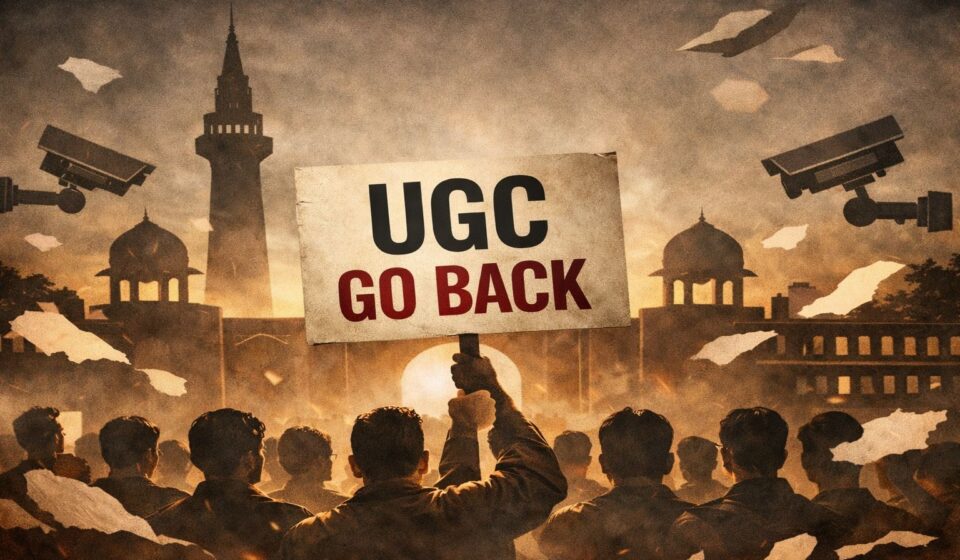
The controversy surrounding this bill is not academic. It is a live political issue. Recent public developments further underscore that the controversy surrounding the 2026 UGC rules is not merely academic or speculative. Multiple news reports indicate that the regulations have triggered political protests, administrative resignations, and public assurances from the Union government developments that are directly relevant to assessing the real-world impact and legal sustainability of the framework.
First, several reports record organised protests by political leaders and local party office-bearers in Uttar Pradesh and other regions against the implementation of the new UGC rules. These protests, including symbolic actions and formal representations to authorities, reflect that the rules are being perceived as having serious distributive and social consequences. From a constitutional perspective, sustained political protest is an indicator that a regulatory framework may be suffering from deficits in legitimacy and stakeholder consultation, factors that courts often consider indirectly when evaluating reasonableness and proportionality in administrative action.
Second, media coverage has highlighted the resignation of a serving city magistrate in Bareilly, reportedly citing objections to the new UGC regulations and their perceived social and administrative implications. Whether or not one agrees with the substance of his claims, the resignation of a serving civil servant over a regulatory policy is institutionally significant. It signals that concerns about the rules are not confined to students or political actors, but extend into the administrative machinery itself. In constitutional terms, this strengthens the argument that the rules may be generating systemic pressure and conflict within governance structures, rather than functioning as neutral regulatory instruments.
Third, the Union Education Minister has publicly addressed the criticism, stating that the new rules cannot be misused and assuring that no discrimination will occur in their implementation. While such political assurances are relevant, Indian constitutional law is clear that executive statements cannot substitute for legally enforceable procedural safeguards. Courts assess constitutionality based on the text, structure, and necessary operation of a regulation, not on assurances of good faith implementation. The jurisprudence on misuse of statutory powers consistently holds that the possibility of abuse is a relevant consideration where the statutory design itself enables arbitrary or subjective enforcement.
Taken together, these developments reinforce a central claim of this article: that the controversy surrounding the 2026 UGC rules is not hypothetical. The combination of protests, administrative fallout, and political damage control suggests that the rules are already producing friction at multiple institutional levels. This strengthens the case for judicial and legislative reconsideration, and for embedding clearer standards, longer timelines, and stronger procedural protections within the regulatory framework.
Conclusion: Equity Must Operate Within the Rule of Law
The UGC’s 2026 equity rules prioritise administrative responsiveness and symbolic enforcement over constitutional safeguards. By embracing vague standards, truncated procedures, and surveillance-style enforcement mechanisms, the framework risks replacing substantive justice with performative compliance.
Under Articles 14, 19, and 21, regulatory action must be non-arbitrary, procedurally fair, and respectful of fundamental freedoms. Equity is a constitutionally valid goal, but it cannot be pursued through mechanisms that erode due process, chill academic speech, and concentrate excessive discretionary power in administrative bodies.
If Indian higher education is to become more inclusive, it must do so through rules that are precise, balanced, and constitutionally robust. A system built on fear of accusation and accelerated punishment is unlikely to produce genuine equality. It may instead produce silence, conformity, and mistrust outcomes that are deeply incompatible with the idea of a university in a constitutional democracy.
Beyond the Verdict



well done!!
Well written. I hope soon they would make necessary changes.
very well written!!